Over the last few days, we have seen significant volatility across all major stock markets as we start to see the impact of the Coronavirus (Covid-19) pandemic. Businesses have been temporarily closed, investments are being held back, employees are working from home, supermarkets are being emptied by panic-buyers and the business climate has deteriorated considerably. Understandably there is a sense of panic. This week with Italy an entire democratic country has been placed under quarantine. These are unprecedented times.Furthermore, as the virus first surfaced in China, it has hit the country particularly hard. This is critical for the global economy, as China is now the world’s largest manufacturing centre and an important source of raw materials. We believe there will definitely be an impact on global growth. While it is difficult to speculate on an exact figure at this stage, we estimate it could be around half a percent. As the crisis continues to develop in Europe and North America, it could be even higher.Given this backdrop, the portfolio of the Mobius Emerging Markets Fund has naturally been affected. Two of our holdings in China will likely be the most impacted. One is a company active in the fast food industry (Yum China) and the other in the entertainment sector (IMAX China). Naturally, they have suffered from the quarantine measures taken by the Chinese government to contain the spread of the virus.The recent news flow from China is more encouraging with newly reported cases declining day by day (down to 24 new cases on 11 March) and we are expecting performance to improve again. It seems China is on the road to recovery. A survey by Made-in-China.com—one of the main platforms connecting Chinese suppliers and global buyers—found that by late February, 80% of manufacturing firms had resumed operations.Overall, the Mobius Emerging Markets Fund has been less affected by the recent volatility than others. The fund outperformed the MSCI Emerging Market Index by more than 7% in the last three months and more than 3% in the last month. If you look at the MSCI EM Mid Cap Index the outperformance is even more pronounced with 10.7% and 5.9% respectively. We are looking to utilise our current cash levels to increase exposure to certain holdings that are now trading at heavily discounted valuations. We are in regular contact with all company management and continue to monitor the portfolio closely.As fundamental investors we take a long term view. Our investment horizon is 5+ years. Despite the mounting number of people infected and the worrying death toll, we believe the impact will diminish over time and the virus will eventually be contained. A tremendous amount of resources is currently being devoted to prevent the spread of the virus and at developing a vaccine.Generally, the case of the Coronavirus is a reminder of how volatile markets can turn over night. As investors we have to be prepared. Portfolios that are globally diversified address this kind of risk and are in a much better position when such events occur.
Category: insights
-
The Relationship Between Strong Governance and Value Creation
Having invested in emerging and frontier markets for over 20 years, I have discovered there is a widely held view that corporate governance standards there are generally lower than those in the developed world. Many understandably assume that this is part of the reason why these markets are classified as “emerging”. Often these concerns discourage market participants from investing in the asset class at all. While I agree that standards can be dramatically improved (across both developing and developed markets), I believe that this deficiency presents an attractive investment opportunity.In a blog at the end of last year, my colleague Greg Konieczny challenged investors to see themselves not as passive share “holders”, but as active share “owners”. At Mobius Capital Partners, we act as flag bearers for this cause. We are not discouraged when we encounter a company with a strong underlying business, but poor corporate governance. Instead, we try to understand whether the company’s board and management are interested in listening to our concerns and implementing a programme of reform. For this to be a success, it is paramount that all stakeholders display a willingness to address the deficiencies and not just pay lip service to the problem. As a result, engaging with management and understanding what truly drives them forms an integral part of our 4-6 week due diligence process before we invest in a stock.We often find ourselves pushing at an open door, and this is particularly true of companies that have a strong controlling family stake. In these instances, our proposed changes are often championed internally by the second or third generation. These individuals have returned from Western business schools with an in-depth understanding of the procedures and transparency expected of a publicly listed company. They are hungry to make these improvements and act as the catalyst for change.One of our holdings, a Turkish denim manufacturer, has already successfully introduced a long-term incentive program for executives based on share price performance and operating profit, aligning the interests of the founding family with those of the senior management and the minority shareholders. Our prior experience enabled us to propose a suitable structure.At this stage you may be asking, why is strong corporate governance so important? One early benefit is that it demonstrates to the wider market the company’s intention to be perceived as a reputable. Often it reflects the start of an evolution from a domestic orientated firm to a more international player. More importantly, strong corporate governance creates a solid foundation on which wider operational as well as social and environmental improvements can be built. This can help us unlock further value within a business and drive a re-rating.On the company level we believe an engagement approach based on partnership will play an increasingly important role in the future of active management. We do not wish to dictate to companies how to run their business, but instead help in creating the optimal conditions within which a company can realise its full potential and ensure a long term and sustainable outlook. This is reflected in our focus on ensuring companies have the appropriate board composition, introduce management incentive schemes and adopt best in class investor relations which includes best in class financial, social and environmental reporting.There are signs that national governance is also improving on the macro level in some emerging markets. For example, China’s Securities Regulatory Commission has introduced voluntary environmental and social reporting guidelines for listed companies, which will be mandatory by the end of 2020. India’s Securities and Exchange Board has introduced new mandatory “business responsibility” reports for the country’s top 500 listed companies. They are expected, in time, to be applied to all Indian businesses. And after years of scandals South Korea’s Chaebols are coming under growing national, and international pressure to reform their antiquated corporate governance arrangements.Corporate governance reform seems to be on the agenda in both emerging and “frontier” markets, and for good reason. The evidence reveals a strong link between corporate governance reform and improvements in financial performance. By integrating corporate governance, and environmental and social factors in our investment process, we can significantly reduce the risk profiles of our portfolios. This translates into higher risk-adjusted returns, and associated benefits for companies, all their stakeholders, and emerging markets as a whole.
-
Q&A Brazil: Risks and Opportunities
**Marcin, you have just come back from a trip to Brazil meeting with companies and investors. How did you find the mood six months after Bolsonaro was inaugurated as president?**The mood in the business community has changed since my last visit to Brazil in December, which was shortly after Bolsonaro’s inauguration. There is less optimism now. Both investors and the electorate are waiting for actual progress on the reforms that the newly-elected president has promised, particularly on pension reform. We agree that reforming the pension system is crucial for the economic development of the country. Currently, Brazil’s spending on social security is among the highest in the world. It continuously adds to the high government debt which the IMF estimates will reach almost 90 per cent of GDP this year.**Recently analysts cut their 2019 growth forecasts for Brazil. Does that impact your investment approach to the country?**Not really. The Brazilian economy has gone through a difficult time over the last 4-5 years and there is a lot of room for improvement once reforms begin to progress. Currently, the economy remains depressed and the 1Q19 GDP numbers of -0.2% q/q and +0.5% y/y[1] failed to show an acceleration of growth. However, there are some positive signs: car sales for May 2019 were strong (21.6% YoY)[2], whilst supermarket sales (Abras)[3] grew 8.1% YoY in April (in real terms).We believe that consumer and investor confidence will improve once the pension reform, in particular, is approved and the reform program springs into action.What do you see as the biggest risks and opportunities for Brazil at the moment?The social security reform bill has now moved to the Lower House Special Committee where amendments may be made. The key issue is to what degree projected savings from the reform might be watered-down. The initial proposal foresaw over BRL1.2 trn (c. 18% of nominal GDP) in savings over 10 years. If this falls significantly, which a first congressional committee report seemed to indicate, this might have a negative impact on the Brazilian equity market.Furthermore, apart from the significant increase in debt over the last 15 years, which now limits the government’s ability to increase spending through borrowing to stimulate the economy, there remain a number of structural issues left behind by the previous governments: the significant share of long-term unemployment (5 million workers have been looking for a job for more than a year; 3 million for more than 2 years) has led to a loss in skills and productive capability. The capital-labour ratio in the economy has declined due to insufficient, mis-allocated, and poor-quality investment for a number of years. And with investment lagging, much of the nation’s infrastructure and many public services are in decay.All of this will take time to correct itself. However, we believe Bolsonaro’s reform program, which is centred around free market policies, is the right way forward.Despite the downbeat mood, opportunities remain.Almost 22 years after Brazil undertook one of the largest privatization efforts in history, the new Bolsonaro administration is aiming to repeat, and perhaps exceed, the previous round. There are as many as a hundred state-owned companies which could be liquidated or privatized as part of Bolsonaro’s privatization plan. With some of those state-owned companies being among the largest in the country, such a move would add significant liquidity to the stock market and provide opportunities for investors like ourselves.If the Bolsonaro administration follows through on the privatization possibilities already put in the pipeline by the previous Temer administration, the government could sell nearly USD90bn (c. 5% of Brazil’s nominal GDP) over the next two years (including state stakes in Petrobras, Eletrobras, BNDES, Banco do Brasil and Caixa Economica Federal).Uncertainties remain about the size and timing of the privatisation programme, however the direction is positive – the less state involvement in the economy, the better for the longer-term outlook of the country. While long-term fiscal sustainability depends more on the social security reform than on privatization, the proceeds will nevertheless help fund the government’s transition and maintain fiscal discipline. Moreover, a well-structured privatization push would rekindle investments and improve the efficiency of the economy.Last but not least, another important item on Bolsonaro’s agenda is increasing the trade openness of the Brazilian economy. Brazil is an unusually closed economy when it comes to international trade (export plus imports as % of GDP is only 23.1% which is way below other emerging economies like India or China with 39% and 37.3% respectively))[4].If successful, this reform could lead to improved productivity and increased growth in the longer term.**What are the things you like about the Brazilian market and where do you see opportunities now?**The most differentiating feature of the Brazilian equity market compared to other emerging economies is the quality of management. You rarely find so much focus on return on invested capital (ROIC) and shareholder value creation elsewhere. In Brazil these considerations drive almost every business decision within an organization.Another characteristic of the Brazilian market is a strong desire to improve efficiencies. This is a common theme within Brazilian companies – whether it is an apparel retailer, auto parts manufacturer or a challenger bank- and is usually driven by the adoption of new technologies.During our visits we have been meeting with a number of interesting companies in the consumer, technology, education and industrials sectors. Generally, we remain cautiously optimistic on the Brazilian equity market as valuations are still at a relatively attractive level with strong earnings recovery to come once the economy returns to growth._________________________________[1]Brazilian Institute of Geography and Statistics[2]The Associacao Nacional dos Fabricantes de Veiculos Automotores (ANFAVEA)[3]ABRAS – Brazil Association of Supermarkets[4]EIU, 2017
-
Indian Elections – Why They Matter For Investors
Indian elections are particularly cacophonous affairs. As the largest democratic exercise in human history comes to an end after six weeks of highly charged voting, many will be relieved that normal life can resume. However, those hoping for an uneventful result may be in for a rude shock. Exit polls released after the final vote was cast on Sunday pointed to a strong Narendra Modi led BJP majority which looked increasingly unlikely just a couple of months ago. Having shocked global markets five years ago by triumphing with the strongest Indian government seen in a generation, Modi may have even bettered his performance in 2014. The polls pointed to the BJP securing over 300 seats of the 543 assembly which would represent improvement from his 2014 scalp of 282 seats. Markets celebrated with the Sensex rallying close to 4% on Monday.It is worth noting that exit polls have struggled with accuracy in the past. Whilst this should come as no surprise to readers in the UK and the US, India’s 2004 exit polls pointed to the BJP winning between 230 and 275 seats. Instead they ended up with only 187 and were kicked out of government. However since then, polling methodologies, sampling and data granularity have improved significantly which diminishes the likelihood of such a severe miscalculation.However, assuming the exit polls have some predictive power, why should this matter for investors and which elements of the reform agenda would then be prioritised?In a period of global policy turmoil, it’s clear that investors seek consistency and predictability. If an emerging market administration is willing to commit to this whilst embarking on a progressive reform agenda, the market will pay up. Whilst debates continue about whether Modi’s first five years had the hallmarks of a Bernie Sanders style administration rather than that of Ronald Reagan, solace can be found through the comfort of BJP’s fiscal conservatism and peerless focus on execution. This will remain in place. Key reforms such as a sturdier Bankruptcy Law, a well-functioning Goods and Services Tax, a flexible inflation targeting regime and success in financially including more than 300m Indians through the biometric identification system have been institutionalised. These will help expand Indian’s productive capacity and propel the country to faster and more sustainable growth. India’s longer term cost of capital will continue to fall.Looking ahead, a BJP led government will likely take less risks in the short term. The rural economy and small businesses have been disrupted by the short term pains of the Goods and Services Tax implementation, whilst demonetisation was largely viewed as a failed and disruptive experiment. The BJP will reward these two sectors for their continued support through a more supportive policy framework. Encouraging private sector participation in agriculture through introducing a regulatory framework for contract manufacturing would be a positive step. The development of modern, large scale warehousing and storage would reduce wastage, boost farm incomes and dampen inflationary pressures.The longer term reforms of addressing bottlenecks in the factor markets of land and labour will be perhaps be the defining feature of Modi’s next five years. Land acquisition continues to be a debilitating constraint to the creation of mid and large scale infrastructure and setting up businesses. Difficulty in acquiring land continues to be the top regulatory hurdle that stalls projects. Addressing this through a transparent auction process, a creative alternative form of compensation and the acceleration of the digitalisation of land records will go some way to relieve manufacturing stress. Tight and constraining labour laws continue to hinder the scale up of organised large scale manufacturing. State government approval is required for firms employing more than 100 workers to lay off staff. It is instructive that the proportion of businesses that employ more than 100 people in India is dwarfed by the respective share in South East Asia and China. India’s much vaunted ‘demographic dividend’ could quickly deteriorate into a ticking time bomb unless job creation is addressed.Clearly a challenging agenda is set out for whoever emerges as India’s next premier. If the exit polls are correct, whilst continuity will remain in place with Modi at the helm, much change will be required to drive India onto a higher plane of growth.
-
ESG in Emerging Markets – Separating Noise From Materiality
How frequently have you heard of the following terms over the last 12 months: ESG, ESG integrated, impact, thematic, responsible investing, sustainable investing, ethical investing? If you tend to group all of these terms together, you are probably not alone. As I write this post, I’m sitting in the airport in Zurich, where I’ve been meeting prospective clients. At the start of one meeting here with a family office, the principal sceptically stated, “oh, not another sustainability fund!” Wariness from clients today is unsurprising given the vast number of terms which are thrown around in the public domain, combined with an abundance of products which are somehow linked to ESG.However, the active ownership approach we take at Mobius Capital Partners is differentiated from mainstream sustainability investing. Our investment philosophy focuses on actively improving governance standards and delivering a clear ESG pathway for our portfolio companies in emerging and frontier markets. As we have previously written about governance issues [see post “Governance is Key” by Mark Mobius], in this post, I will focus on how we approach ESG integration, and in particular, how environmental and social factors impact pricing, growth, cost savings, and risk.Whilst there has been considerable progress in Europe and the U.S. with regards to ESG standards, many companies in emerging and frontier markets lag behind their peers in developed markets. This is particularly true in small and mid-cap companies in emerging markets which are often run by entrepreneurs and families. These companies are more likely to suffer from poor investor relations, sub-optimal corporate governance, and provide limited protection to minority shareholders. What does this therefore mean for active investors like ourselves? The approach one takes in these markets requires rigorous research and a tailored engagement plan. Our bottom-up fundamental research considers all relevant information which can improve a company’s operations. We do not constrain ourselves to conventional definitions of ‘ESG’ but also assess political, macroeconomic, legal, and accounting factors. As global emerging and frontier market investors, we are cognisant of the variation of regulatory frameworks throughout our investment universe. Accordingly, we do not employ a blanket policy across our investments, but rather, focus our efforts on our customised active ownership strategy, which assesses companies on a pragmatic case-by-case basis.There are essentially two elements to this approach:
- Governance
Our area of engagement is very broad, but is focused on increasing long-term shareholder value. Potential governance improvements may be made in, but are not limited to: capital allocation, management remuneration structures, board independence, balance sheet restructuring, investor relations, capital structures, acquisitions, and divestures.When we identify such problems through deep research, we address these in private meetings by partnering with management teams, boards, and controlling shareholders. We strongly believe that a regular constructive dialogue is the bedrock of the active ownership approach we pursue.
- Environmental and Social
Our analysis goes beyond assessing pure environmental and social factors. We recognise that each company and sector presents unique environmental and social challenges. We focus on how these can be improved and how this can have a positive impact on long-term financial performance. This encourages us to concentrate on material factors such as selling practices, energy efficiency or employee relations. These can, in turn, impact operational areas such as pricing power, market share, operating costs, employee retention, and productivity.We believe environmental and social factors can impact emerging market companies in the following ways:1) Pricing: companies with strong quality assurance, a robust and transparent supply chain, high quality labelling, and packaging will often benefit from a stronger brand over their peers. This allows companies to charge premium prices, and accordingly, benefit from both topline growth as well as the ability to offer higher margin products or services. Taking the infant milk formula sector in China as an example, it is evident that poor supply chain and quality standards, combined with suboptimal health and safety standards hurt domestic Chinese players in the sector. During the melanine scandal in China in 2008, more than 300,000 babies became sick or were hospitalised. As a result, millions of Chinese consumers lost trust in domestic brands and turned to premium foreign brands. The top 20 foreign infant milk formula companies in China increased their market share from 35% in 2007 to over 53% in 2017. At the same time, domestic brands witnessed their market share decline from 41% in 2007 to 30% in 2017. It is also worth noting that prices for infant milk formula have almost doubled over the past 15 years.2) Growth and cost savings: companies with a market leading sustainability profile will benefit from a powerful brand which allows them to grow faster over their peers. Such companies benefit from growing their market share whilst potentially expanding into new categories and segments. For example a bank in Bangladesh which is known for microfinance lending to women has seen faster loan growth compared to its peers. Companies which run their business operations in a sustainable way should also benefit from higher margins and profitability. Whether this relates to reducing their input costs by lowering their utility bills to increasing productivity by lowering employee turnover. One example of this is an Indian beverage company which has seen a 600bps improvement in its gross margin due to lowering its water usage and offering customers the opportunity to recycle bottles. In resource constrained markets, such measures are critical to optimise efficiency whilst yielding tangible results for shareholders. 3) Risk: a body of recent research shows that companies with high ESG credentials benefit from a lower risk premium. This is captured via a lower cost of capital, lower business risk, as well as better access to financing. One example of this is in the banking sector, where we now see several emerging market banks assessing the ESG credentials of companies before they underwrite corporate loans. Companies with higher ESG standards are accordingly benefiting from a lower cost of funding.Evidently, integrating environmental and social factors into an emerging and frontier markets portfolio entails more than relying on quantitative scoring and third-party research. It requires a deep understanding of the business, a thorough analysis of what drives value and a strong awareness of a company’s resource productivity.During our many years of investing in emerging and frontier markets, we have observed a strong link between ESG engagement and improvements in the financial performance of our portfolio companies, particularly in the small and mid-cap sector. We strongly believe that capturing the improvement in ESG standards in emerging and frontier markets offers a greater opportunity to generate long-term returns whilst simultaneously mitigating risk.
-
Book Club: What We’re Reading And Why – April 2019
What we read and whyMy reading is rather eclectic. In fact, algorithms of online booksellers would find it quite difficult to provide me with new recommendations based on my previous purchases.For example, in the last few months I have read “ The Facebook Effect” by David Kirkpatrick, “Trump, the Blue Collar President” by Anthony Scaramucci, “Bad Blood” by John Carreyrou, “Anyway you Can” by Annette Bosworth and “Sycamore Row” by John Grisham. So I’ve gone from internet successes to political commentators, to financial scandals, to healthy living to legal mysteries – in a few weeks.“The Facebook Effect” is a very interesting insight into the rapid growth of Facebook from a small undergraduate online community to the global phenomenon it is today, driven by a visionary Zuckerberg whose overriding ambition has been to connect everyone in the world. The book provides a well-rounded assessment of Facebook’s “rise to power” and includes a critical analysis of how social media has changed our lives, for better or for worse.“Trump, the Blue Collar President” is a highly entertaining and insightful read about Donald Trump by the former and very short lived White House Communications Director Anthony Scarramucci. Scarramucci was fired days after his appointment because of an indiscreet conversation with a reporter in which he lashed out at a number of senior White House officials. While Scarramucci remains a Trump supporter he does not hold back in the book on criticisms either.“Bad Blood” by the Wall Street Journal Reporter John Carreyrou is the incredible true story of an ambitious young woman who promised to revolutionize the medical industry with a small device that would enable a wide variety of blood tests with only one drop of blood. She was able to raise hundreds of millions of venture capital funding and persuaded very prominent names to join her board including former Secretary of State Shultz. Only the device didn’t work. The company went bankrupt when Carreyrou revealed that the firm was cheating by secretly using larger, sophisticated equipment in order to obtain the required results.In “Anyway You Can” the author “Dr. Boz” describes how the keto diet helped her cancer-stricken mother to survive. The diet focuses on high fat and low carb consumption in order to increase the ketones and reduce the insulin in the blood, which has highly beneficial effects on general health as well as weight issues. I’ve tried it and it works.Finally, John Grisham’s bestselling legal thriller “Sycamore Row” takes place in the American South. A white man commits suicide and leaves most of his wealth to his black maid, much to the chagrin of his immediate family. There is a surprise ending which ties up the various threads of the story beautifully. A riveting read.
-
Q&A with Marcin Lewczuk
**MCP: Can you tell us about your career up to date?**Marcin: My passion for capital markets and investing dates back to university. (My first stock investment at the time proved to be a rather painful experience!) This led me on to an internship at an asset management company and the realization that this was the career path I wanted to pursue.Prior to joining Mobius Capital Partners, I was part of the emerging markets equity team at Franklin Templeton where I co-managed the Eastern European Fund and was responsible for sourcing investment opportunities from the region. I was also a member of both the Templeton’s emerging market private equity strategy as well as the active ownership group – two initiatives that deepened my interest in active investing.**Why did you decide to join Mobius Capital Partners?**I strongly believe in the investment strategy of the firm and the team behind it. I am convinced that an investment strategy which combines deep fundamental research with active ownership can deliver positive risk-adjusted results.By actively engaging with portfolio companies, we aim at creating value by improving their ESG framework and positioning as well as their perception among other investors. At the same time we work with the companies to improve their business operations.During my years at Templeton I observed that the greatest opportunities in emerging markets could be found within the small and mid-cap space. These companies are still relatively undiscovered by international investors and often offer above average growth prospects.Mobius Capital Partners combines all these elements in one strategy and I am excited to be working with their experienced team on the execution of this unique approach.**Where do you see the greatest potential in Emerging and Frontier Markets?**In the current environment we see plenty of opportunities across different geographies. The last twelve months have been particularly difficult for emerging markets as concerns about the trade war and China’s slowdown have negatively impacted many EM currencies and market valuations. But depreciated currencies and low valuations have created opportunities for investors. For example, we see significant potential in the consumer and technology related sectors, which present the largest number of companies with sustainably growing business modelsFurthermore, the vast majority of companies in our investment universe are not familiar with the concept of ESG and the impact it may have on their valuation over the long term, so there is an interesting upside potential there.When it comes to particular countries, I do believe that the Brazilian equity markets offer countless opportunities as the economy is just about to recover after several difficult years. With the new government under President Bolsonaro’s leadership, we are positive about the prospects for the economy and see a number of opportunities in the consumer and industrials related space there.**Why do you believe in ESG investing?**I personally believe that ESG is nothing new to the industry – many investors have previously paid attention to the environmental, social and governance risk factors in their investments, at least to some degree. But I am glad to see that ESG has gained more prominence. By taking ESG factors into account, investors can significantly reduce the risk profile of their investments, which over the long term not only translates into positive risk-adjusted returns, but also positively impacts all stakeholders. I am convinced this is the future of investing.In emerging markets, the “G-overnance” part of ESG investing plays a particularly important role. Despite the significant progress made in recent years, most EM companies still lag behind their developed-markets peers in this respect. There remains great potential for improvements in terms of how EM companies are governed and how minority investors are treated.**Your home country, Poland, has recently been upgraded from an “emerging market” to a “Developed country” by the FTSE Russell, the first country in almost a decade to be upgraded, and the first in Central and Eastern European. What in your opinion were the (economic) milestones since the fall of the Soviet Union, allowing for this re-rating?**Poland’s modern history has indeed been very complex and the country has undergone profound changes economically, politically and socially over the past three decades. Poland’s entry into the European Union in 2004 was a key milestones in our recent history. It created a big opportunity for Polish corporates who were now able to access the common market and it provided significant funding. But possibly most importantly for the first time Poles were able to work and study abroad. This I believe contributed to Poland becoming the dynamic and very entrepreneurial country it is today.**In another life, what would be your dream job?**I could imagine myself as a travel writer, – penning travel guides at some exciting off-the-beaten track location. Even though I cannot travel now as often as I used to, I remain a passionate backpacker, excited about getting to know new cultures, people, places and – last but no least – cuisine! (the spicier, the better!).
-
“Every market crisis always creates winners and losers” – Mark Mobius on Emerging Markets
This Interview was originally published by Investorama Magazine of LGT Capital Partners Ltd 2018 was a very difficult year for the markets in general and emerging markets in particular. The markets continued to set new lows, testing the patience of investors. In terms of fundamentals, however, the emerging markets remain an attractive investment destination. The expert and pioneer for investments in emerging markets, Mark Mobius, makes the case in the following interview that this asset class still offers lucrative opportunities despite the challenging market environment.Investorama: From a fundamental point of view, emerging markets (EM) seem to be less vulnerable compared to previous episodes of EM stress. Still, the asset class experienced significant drawdowns during 2018. How do you explain this sell-off? Mark Mobius: The sell-off was primarily due to the strong US stock market and the strong US dollar which attracted investment dollars to the US. The threat and then the reality of a trade war, accompanied by a strengthening dollar, have contributed to a bear market. Currencies have weakened in the vast majority of developing nations, while Turkey and Argentina have suffered financial crises. The MSCI Index has fallen around 16% last year.But there are also some positive signs. These markets remain the fastest growing economies in the world. The International Monetary Fund estimated that EM will grow 4.7% in 2019, more than double the predicted growth for developed countries. Furthermore, FX reserves have increased almost five times, from USD 1.7 tn to over USD 8 tn, between 2002 to 2017. EM government debt (as a % of GDP) is now lower than in 2002. This mitigates concerns about the rising cost of hard currency interest payments. Crucially, intra-EM trade has also increased significantly in the last few years, now representing 41% of total EM trade. This makes local champions far less dependent on developed markets.Most crucially, EM now offer a dramatically more attractive set of companies that no longer follow the developed markets – they lead.**Which factors are clouding the outlook for EM?**From an investor psychology point of view many would become bearish if the US-China trade war continues, oil prices go back up and US interest rates move above a 5% level. But the US-China trade war is beneficial to a number of EM since they will pick up the manufacturing and export business that China has to abandon. As regards to interest rates, much of that has already been discounted and – unless rates in the US go above 5% – much of the interest rate expectation is already in the prices and exchange levels. So those factors cloud the outlook but are, at least for 2019, not critical.**What could trigger the next EM bull run?**A halt in US interest rate rises and a subsequent weakening of the US dollar could trigger an EM bull run. Also positive growth numbers in those markets, although they already are good, would be another trigger. A rise in populist policies would be another trigger. For example, in India there are proposals by the government to cancel farm loans and at the same time recapitalize the banks. This would result in a surge of spendable cash in the hands of consumers resulting in a consumption boom. Although such free spending government policies could result in future financial instability and inflationary tendencies, in the short-term they would be bullish for markets.**Given the current pessimism of market participants, are their fears justified or is it time to take a contrarian approach and buy EM?**Many market participants have been holding off investing amid the recent volatility, particularly in view of falling EM currencies. We should acknowledge that this offers more attractive prices for overseas investors.Every market crisis always creates winners and losers. It is our job as investors to ensure that we can dig out the winners. The sharp drop in currencies and the fall in the market give investors a double opportunity for potential upside.**Where do you see attractive investment potential in EM (e.g. countries, sectors, corporates)?**Countries like Argentina and Turkey, that have suffered the most from the recent crisis, could offer the greatest opportunities. In terms of its economic size and export potential, Turkey could be particularly interesting. However, this is contingent on whether the volatile political situation calms down. At this stage, it is all about winning back the confidence of investors. With the Lira down, any exporter will be in a good position to trade with developed countries. At the same time, the currency crisis makes investments in Turkey relatively cheap.Generally, the global currency depreciation is a big opportunity for EM. It will allow them to grab a bigger share of the export market. Furthermore, countries like Brazil, Mexico and India, for example, could benefit from a continued trade war between the US and China. Brazil could sell more soybeans to China, Mexico could take a portion of Chinese auto parts exports, while India could grab some of the manufacturing capacity moving out of China.As investors, these changes to the status quo and the knock-on effects are where we see greatest opportunities.EM have been the winners of the (hyper-)globalization of the past decades. Is the fact that we have reached the peak of this development and globalization’s momentum is declining a chance or a threat for EM? EM are estimated to grow more than double the rate of developed countries this year. A lot of this growth is coming from intra- EM trade and internal demand.Populations and living standards in emerging and frontier markets have ballooned, creating enormous middle classes with growing consumption levels. Furthermore, there has been a notable shift from traditionally export-driven industries such as textiles, towards sectors such as technology. These new industries tap much more strongly into the home market. When I go to trade shows, it is increasingly the EM companies that have started to dominate in areas such as robotics and high value component manufacturing. Intra-EM and especially intra-Asian trade is a common characteristic for a number of sectors such as technology, fashion, shipping and media.In China, technology ‘unicorns’ are being born with increasing frequency, without ever leaving the domestic market. In Indonesia, entire sectors (such as banking) remain undeveloped, offering numerous multi-billion-dollar markets to tap into for Southeast Asian companies that can combine cultural and domain expertise.These sorts of domestic and regional growth opportunities, regardless of what happens in developed markets, offer resilience at a time when many are concerned about a fallout from the ongoing trade war and a decline in the globalization movement.Therefore, I believe that developing economies are well positioned to generate significant and sustainable returns. As a result, this year we might be seeing more money flowing back into EM stocks.Dr. Mark Mobius co-founded Mobius Capital Partners LLP in May 2018, an emerging and frontier markets asset manager offering innovative and sustainable investment solutions. Prior to that Dr. Mobius was with Franklin Templeton Investments for more than 30 years, most recently as executive chairman of Templeton Emerging Markets Group. Dr. Mobius is an internationally recognized pioneer of emerging markets investing and a member of the Economic Advisory Board of the International Finance Corporation (IFC). His career and influence has earned him numerous industry awards, including most recently the Life Time Achievement Award in Asset Management (2017, Global Investor Magazine) and 50 Most Influential People (2011, Bloomberg Markets Magazine).
-
South Korean Corporate Governance
Moon Jae-in was elected as South Korea’s president 18 months ago after the impeachment and imprisonment of his predecessor Park. His mandate was clear: drive out corruption and improve corporate governance, particularly at the nation’s Chaebols. It started well: he appointed Kim Sang-Jo as the Head of a Fair Trade Commission. The so-called “Chaebol Sniper” has been a long time governance crusader, and his role was to curb the excesses of the Chaebol. But the initial enthusiasm was followed by disillusionment. Kim Sang Moon’s domestic agenda has lost momentum as reconciliation with North Korea has seemingly become his priorty. And his voters are far from happy: workers repeatedly took to the streets in November to protest Moon’s lack of reform. With an domestic economy in jeopardy and governance reform on the ropes, the “Korea Discount” is back.
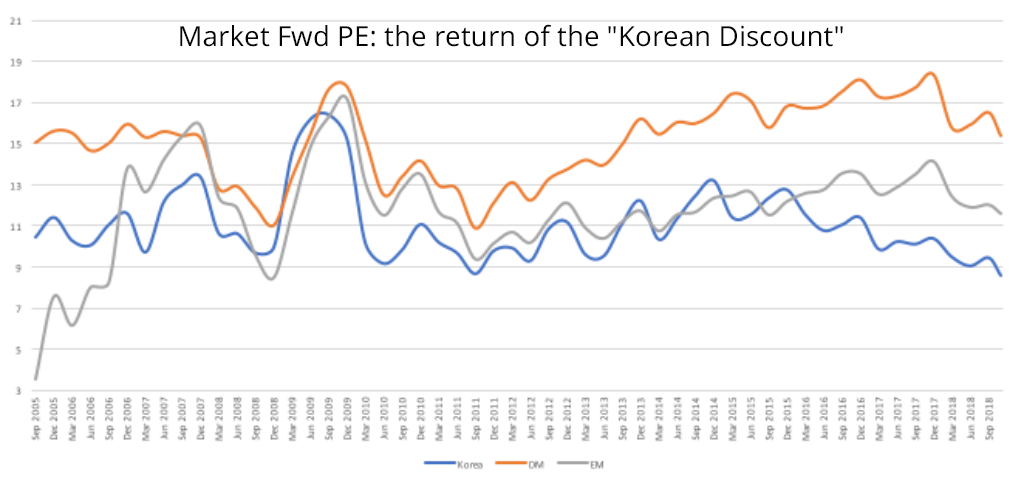
Source: Bloomberg
The Rise of the Chaebol Context is key. In the 1960s Park Chung Hee (killed by the head of the CIA in the Blue House, 1979) enrolled the help of leading businessmen to rebuild Korea. The “Miracle on the Han River” transformed Korea from a war ravaged country with per capita GDP below $100 to the economic powerhouse it is today, where per capita GDP stands at near $30,000. The achievement was astonishing – within barely two generations – and it was mainly down to a small group of entrepreneurs and their “chaebol”, the conglomerates they built in the process.[1]The Chaebol touched and continue to dominate all aspects of the economy. There are two dozen or so Chaebol remaining – of which Samsung, Hyundai and LG are the most famous. Their power is enormous – sprawling, interconnected webs of businesses in sectors as diverse as heavy industry and biotech. But with generational change, the Chaebol have fought to maintain their wealth and with that governance has suffered.Misaligned interestsBecause of an incentive structure skewed towards the preservation of control rather than the creation of value, Korean governance has been marginalised. The reasons are varied: 1) why disclose information which could jeopardise a competitive edge or anger customers; 2) why engage actively with financial markets when the focus is to build relationships with a few key clients; and 3) (in extreme cases) why increase your company’s valuation before a transitional period when the top rate of inheritance tax is almost 50%. Ironically, from the perspective of owner-managers and the wider shareholder value movement, there is no quicker way to weaken an owner’s control over a company than to attract external investors who increase its valuation. The result is webs of inter-related companies (despite improvements), excessive cash positions and limited focus on shareholder returns.Pressure to reformUntil recently, it was a given that what is good for the chaebol is good for South Korea. But this has changed after years of scandal and subterfuge. President Moon’s election in 2017 brought optimism around reforms to make Korean corporate governance more transparent, crystalising efforts made by previous administrations. Crucially the National Pension Service has adopted a formal stewardship code in July this year. The explicit aim is to push for better governance, transparency and accountably from its portfolio companies.[2]South Korea is at an economic cross-roads. The high growth days post-Asian crisis are long gone and Korea’s economy grew 2% year-on-year at the third quarter 2018, the slowest on-year growth since 2009. The export model that served them so well is faltering. China is doing to Korea what Korea did to Japan; and this is most evident in Korea’s biggest companies. Samsung Electronics’s market share in China has fallen from >20% in 2013 to less than 5% now; Hyundai Motor & Kia have lost 5% of market share to domestic auto manufacturers. The Korean economy is increasingly reliant on consumption – but consumption growth is tepid. The housing market is over-heating (despite the government’s efforts to dampen it), minimum wage regulation – designed to raise basic earnings – has just pushed jobs overseas, strained small and medium businesses, and reduced Korean competitiveness.
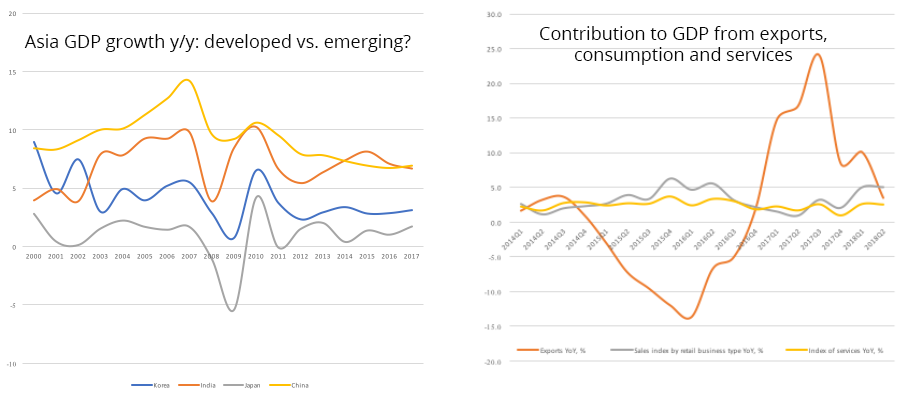
Source: Bloomberg
Opportunity for changeTax reform is rarely a subject to set pulses racing but in Korea it is essential: Korean individuals – particularly the third generation owners of Chaebols – are disincentivised to pay-out cash because they pay so much tax on their income.This goes some way to explain why the Korean market’s pay-out ratio is the lowest of major global markets at 20.8% (even Japan’s at 30% is higher); and why Korean company owners and managers are so pained to raise dividends. Ironically, tax code reform was taken off the agenda by a left-leaning president – partly because it is seen as a fillip to the oligarchs. President Park planned to address it.The corollary of higher pay-out ratios is focusing investment decisions on return on equity or return on invested capital: management deploying capital only when it makes economic sense, not because a client or the chairman says so. Employee stock option schemes – aligning interests between managers and owners – are rare. Adopting compensation structures which align the interests of owners, managers, employees and minority investors would be a marker to international investors that the old, misaligned ways are gone.Investment outlook The outlook is far from gloomy, however. After years of engaging with management teams, we are always impressed by the expertise and dedication they show. Korea is not the finished article, but change is afoot, and this brings the chance for re-ratings. Activist funds are springing up domestically, encouraged partly by the efforts of Elliot Advisors. In November Korean Airlines parent company was engaged by a local private equity house, the first high profile domestically driven activist case. This has sent shockwaves through boardrooms. A recent trip to Seoul confirmed how emboldened locals are feeling. Change is underway and corporations – feeling the pressure from investors – are taking notice.Our approach at Mobius is relatively straightforward: target companies offering earnings and cash flow growth trading at discount to their intrinsic valuations. Avoid businesses at risk from being disrupted by “China Inc.” and seek companies that have experienced generational change of ownership. There are several exciting opportunities in fast growth sectors (medical technology, ecommerce, gaming) but also less glamorous sectors (food products and turnarounds in heavy industry). South Korea is a source of world class intellectual property – from semiconductors to biotechnology and materials science. These companies are leaders in their fields and many trade at steep – and unjustified – discounts to international peers.We are excited about what the future holds. In the near term, it would help if Moon refocused on his agenda.[1] “jae” – wealth or property; and “beol” – faction or clan[2] NPS is itself not unfamiliar with corruption – the Chairman, Moon Hyung-Pyo was caught up in the scandal which ended President Park’s term.
-
A Letter from São Paulo
I arrived in São Paulo from Dubai in Mid December and found Brazil’s largest city bustling as usual and with the characteristic traffic jams. We had a number of meetings scheduled and people within the business community seemed generally optimistic in view of the incoming president Bolsonaro and his economy or “super” minister, Paulo Guedes.Bolsonaro’s agenda for the economy has two parts. First, fiscal austerity to reduce the public debt and second, increased productivity. On the productivity side, Bolsonaro and his economy minister are planning to pursue a very ambitious agenda to remove bottlenecks to infrastructure spending, cut red tape, and lower trade barriers. This kind of program would be a real revolution for Brazil since the country has generally pursued a closed economy policy. For fiscal austerity, the incoming president is planning to cut public spending, in particular through reforming the country’s costly pension system, while on the other hand raising revenues by selling state-owned assets.There are as many as a hundred state-owned companies which could be liquidated or privatized. These include the Brazilian post offices (Correios), the loss-making biotechnology company Hemobrás, and the logistics planning company EPL. With some of those state-owned companies being among the largest in the country and such a move would add a great deal of liquidity to the stock market and provide opportunities for investors like ourselves. Along with helping the government raise revenues to cut debt, the privatization program would also help to reduce inefficiencies in the respective sectors.The most important privatizations will involve Petrobras, Eletrobras, Caixa, and Banco do Brasil since, together, they account for a large part of the net worth of all federal state-owned companies. The fact that the government is unlikely to relinquish majority control would limit the amount of revenue upside. However, the huge electric company Eletrobras could be liquidated by the government, with the government relinquishing control to a share offering. This could result in over R$10 billion flowing into the pockets of the treasury.It’s important to note that the outgoing president, Michel Temer, had already advanced the privatization plan. Temer’s group had started analyzing the sale of the national mint (Casa da Moeda do Brasil) and sold all but one of the Eletrobras distribution companies. They were planning to put up minority stakes and some federal airports for auction. In addition, the start was made under Temer to auction off railways that laid the groundwork for Bolsonaro to liquidate Valec, the state-owned company which builds, maintains, and operates Brazilian railways.I was pleased to hear that Salim Mattar will become the secretary for privatizations and sales of real estate assets. Mattar is a founder and chairman of the board of the Localiza Rent a Car SA , which he turned into one of Latin America’s largest car rental firms. I remember visiting one of their call centers a few years ago and at the time I was impressed by their efficiency and the innovative methods they used.However, the privatization program faces some constraints. The Brazilian Congress would be the first hurdle but not a major one, according to political commentators. A second constraint would be the Federal Audit Court (TCU), as they are responsible for analyzing such sales. There are also several judicial challenges that come up in such asset sales, but usually, although time-consuming, they are overturned. In my opinion, the faster these constraints are overcome, the better it will be for the country_Since my journey to Brazil Bolsonaro has taken office. And we remain confident that Brazil is on a new path of reform and change. The country will stay a focus of Mobius Capital Partners’ investment strategy, and we have recently made our first investments in Brazil._