We were delighted to host our annual MCP Investor Day in London on 24 September 2026, bringing together investors, portfolio companies and industry experts.
Joongsuk Han from the Korea Exchange (KRX) discussed Korea’s Value-Up Program and corporate governance reforms. We also heard from Will Wang of King Slide Works and Sharad Khandelwal of GNG Electronics on their businesses and growth outlook.
Carlos von Hardenberg and the MCP team shared recent portfolio developments, research insights and their outlook for emerging markets, including opportunities across AI, technology, financials and industrials.
For those unable to attend, the full recording is available online. We thank everyone who joined us in London and online, as well as our guest speakers for their valuable contributions.
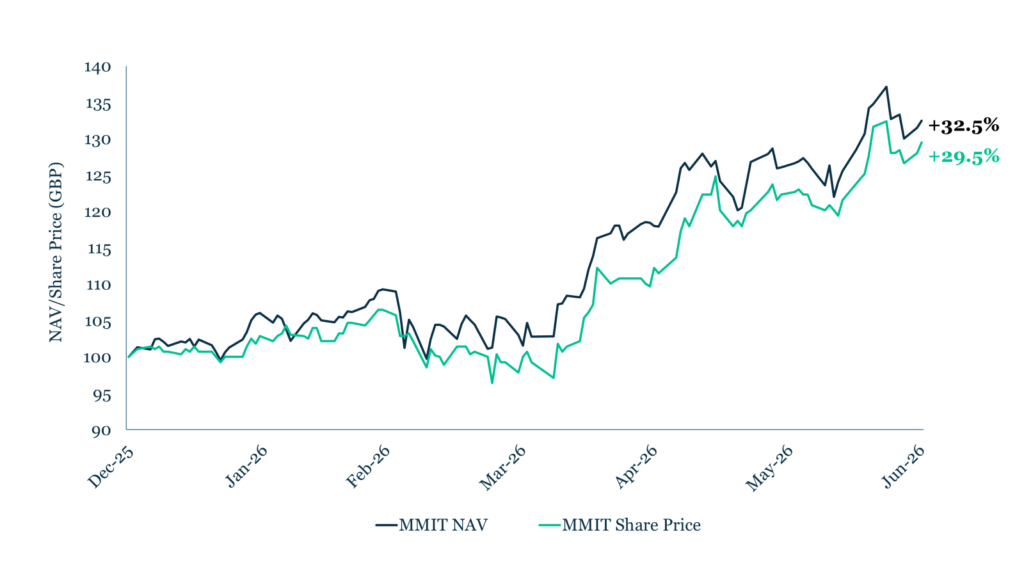
This quarter was characterised by strong equity market performance, although returns remained highly differentiated across sectors and companies. Continued investment in artificial intelligence (“AI”) infrastructure supported parts of the technology supply chain, particularly in Taiwan and South Korea, while the easing of the style headwinds experienced in 2025 created a more supportive backdrop for MMIT’s focus on quality growth businesses. Against this environment, the Trust delivered NAV and share price total returns of 32.5% and 29.5%, respectively, compared with 18.6% for the MSCI Emerging Markets Mid Cap Index (Net TR GBP).
MMIT Performance YTD
Source: Bloomberg. Figures in GBP. Figures refer to past performance. Past performance is not a reliable indicator for future performance.
The continued acceleration of AI capabilities and the widening gap between companies likely to benefit from this transition and those whose business models may be challenged by it remained the defining investment theme during the period.
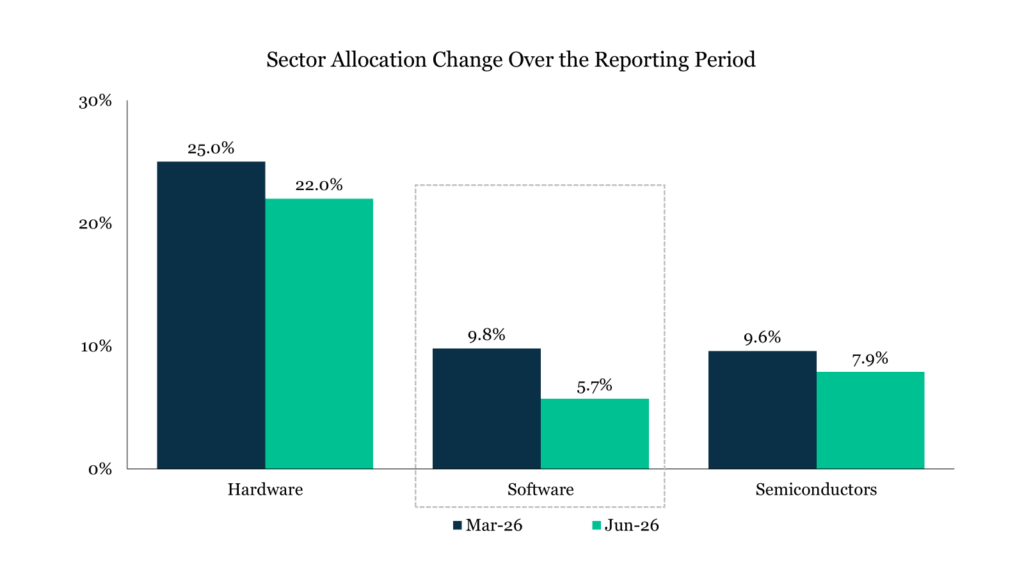
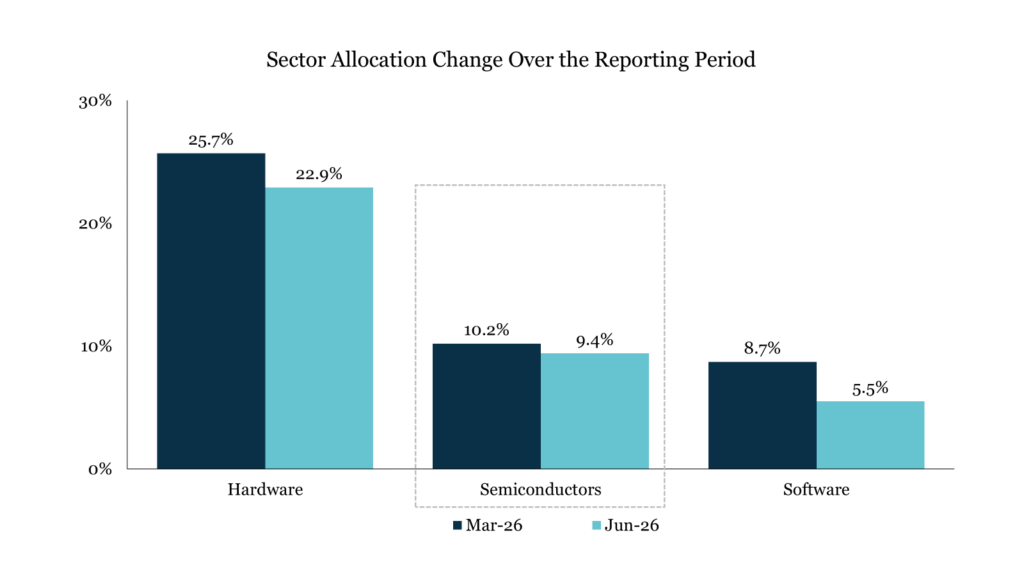
As discussed in our Q1 commentary, this is a continuation of the trend we identified during 2025, when we began repositioning the portfolio to reflect the rapidly evolving AI landscape. During the quarter, we further refined portfolio positioning, reallocating capital towards companies offering greater long-term earnings visibility and more resilient competitive positions, while reducing exposure where rapid advances in AI have increased uncertainty around future business models. This was most evident within the software sector, where increasingly capable AI systems have the potential to reshape enterprise software and IT services business models. Capital was redeployed into businesses offering stronger growth drivers, greater earnings visibility and more attractive risk-adjusted return potential.
Evolution of Technology Sector Exposures Over Q2
Source: Bloomberg, MCP. Allocation may vary over time.
Following strong share price appreciation across parts of the semiconductor and hardware supply chain, we also reassessed the long-term return potential of a number of holdings. Consistent with our disciplined investment process, we reduced positions where share prices approached our estimates of intrinsic value, recycling capital into opportunities offering a more attractive balance of long-term return potential and valuation, while maintaining meaningful exposure to our highest-conviction AI holdings. Importantly, we believe the opportunity extends well beyond semiconductor manufacturers, creating attractive prospects across the wider technology supply chain.
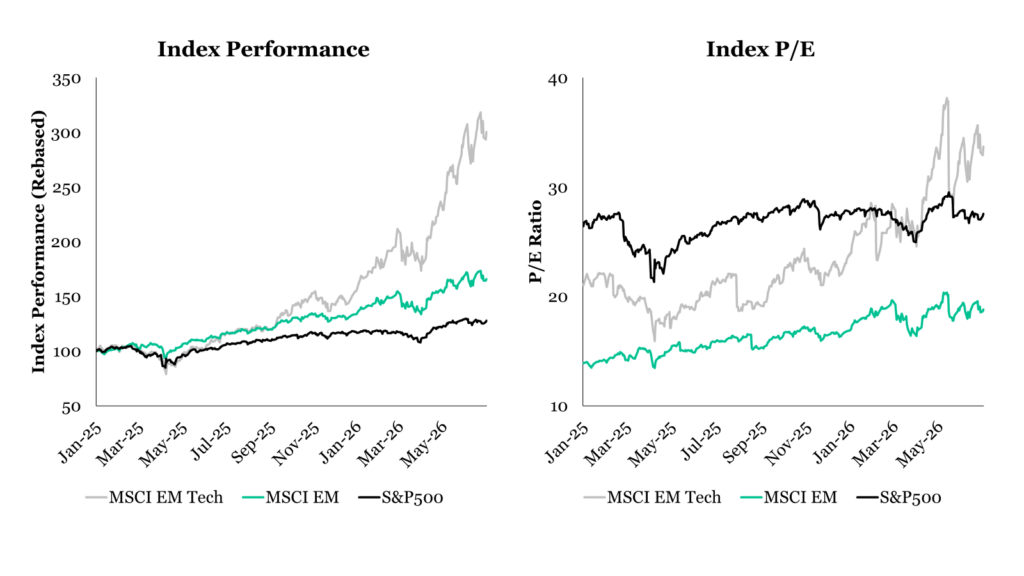
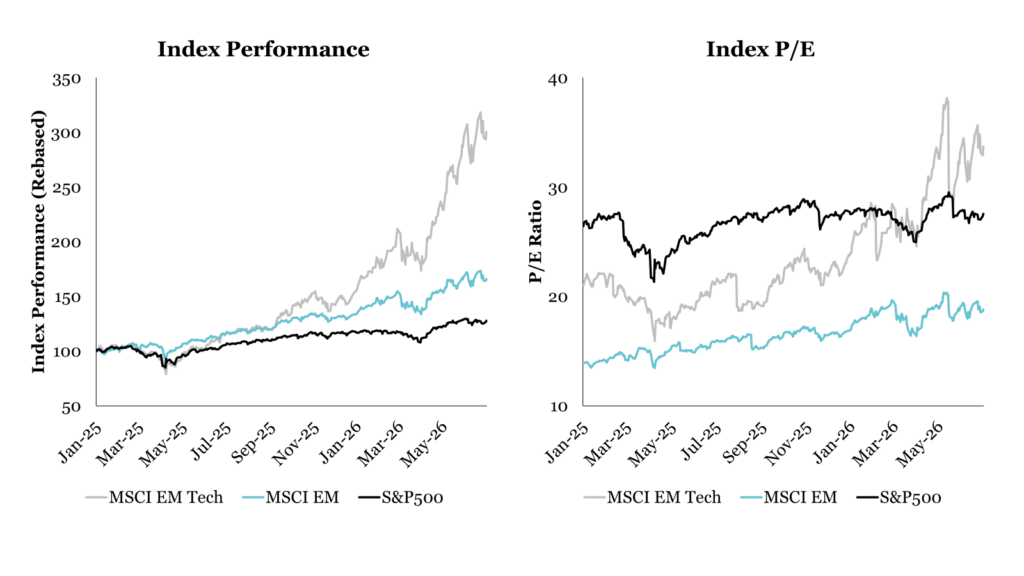
EM Technology Outperformed as Valuations Re-rated
Source: MCP, Bloomberg.
India was one of the strongest-performing emerging markets during the quarter, outperforming most major regional peers, including South Korea and Taiwan, and second only to Thailand. The Nifty 50 Index rose 6.7% over the April–June period in USD terms1, while performance was even stronger further down the market-capitalisation spectrum, with the BSE 500, mid-cap and small-cap indices outperforming the Nifty by approximately 5, 10 and 17 percentage points, respectively2. As discussed in our Q1 commentary, our research, including regular visits to India with extensive on-the-ground research, reinforced our conviction that the country’s long-term investment case remained intact, leading us to increase exposure during the earlier period of market weakness. The subsequent recovery supported that positioning, particularly among what we consider quality smaller companies, where we continue to identify the most compelling structural growth opportunities.
Geopolitical developments, including tensions in the Middle East, evolving trade policies, an increasingly uncertain monetary policy outlook and broader macroeconomic uncertainty, contributed to periods of market volatility. We monitored these developments closely, assessing their implications for energy prices, inflation, financing conditions, supply chains and investor sentiment, while incorporating these factors into our ongoing assessment of portfolio risks and opportunities.
Overall, the period reinforced the importance of active portfolio management in a rapidly evolving investment landscape. While artificial intelligence remained an important driver of investment opportunities, our investment process extends well beyond technology. We continue to find compelling opportunities in Taiwan and Korea among companies supplying critical components, advanced materials and testing equipment to the AI ecosystem, while India remains an important area of focus, supported by resilient domestic demand, infrastructure investment and the continued financialisation of household savings. Recent research trips to India and Vietnam reinforced our conviction in several existing holdings and expanded our pipeline of prospective investments.
While geopolitical developments, shifts in trade, and monetary policy are likely to continue contributing to periods of market volatility, our investment decisions remain driven by company fundamentals rather than short-term market movements. At the same time, the pace of change across the AI landscape, together with evolving opportunities in India and other emerging markets, continues to create a dynamic investment environment. Against this backdrop, we remain focused on identifying exceptional businesses, led by capable management teams, with durable competitive advantages and the ability to compound value over many years. We believe this approach leaves the portfolio well positioned to navigate an evolving market environment and deliver attractive long-term returns.
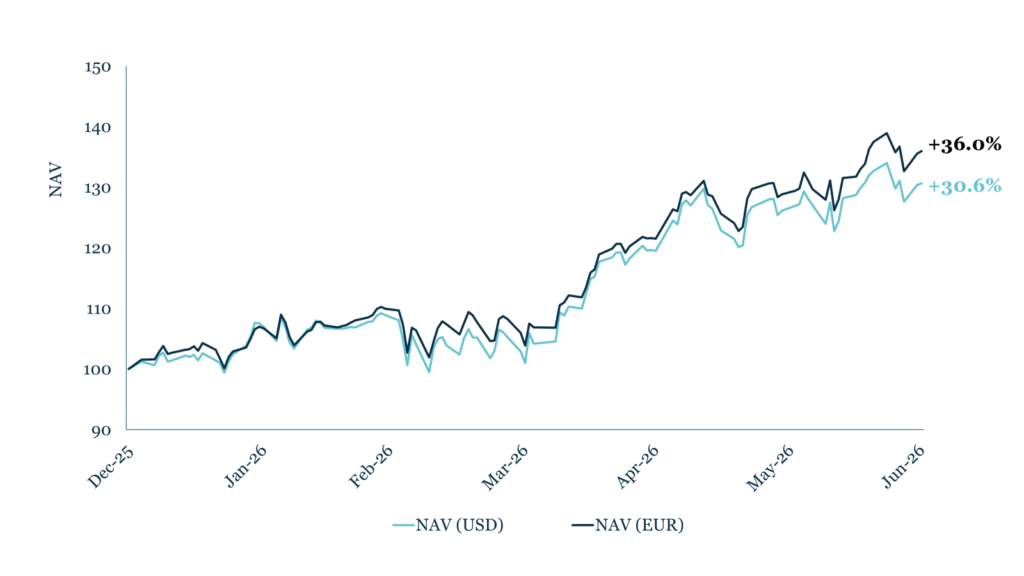
This quarter was characterised by strong equity market performance, although returns remained highly differentiated across sectors and companies. Continued investment in artificial intelligence (“AI”) infrastructure supported parts of the technology supply chain, particularly in Taiwan and South Korea, while the easing of the style headwinds experienced in 2025 created a more supportive backdrop for MEMF’s focus on quality growth businesses. Against this environment, the Fund delivered a NAV return of 29.4% (Private C USD Founder) and 30.9% (Private C EUR Founder), respectively, compared with 19.0% for the MSCI Emerging Markets Mid Cap Index (Net TR USD).
MEMF Performance YTD
Source: Bloomberg. Founder C Euro, Founder C USD. Figures refer to past performance. Past performance is not a reliable indicator for future performance.
The continued acceleration of AI capabilities and the widening gap between companies likely to benefit from this transition and those whose business models may be challenged by it remained the defining investment theme during the period.
As discussed in our Q1 commentary, this is a continuation of the trend we identified during 2025, when we began repositioning the portfolio to reflect the rapidly evolving AI landscape. During the quarter, we further refined portfolio positioning, reallocating capital towards companies offering greater long-term earnings visibility and more resilient competitive positions, while reducing exposure where rapid advances in AI have increased uncertainty around future business models. This was most evident within the software sector, where increasingly capable AI systems have the potential to reshape enterprise software and IT services business models. Capital was redeployed into businesses offering stronger growth drivers, greater earnings visibility and more attractive risk-adjusted return potential.
Evolution of Technology Sector Exposures Over Q2
Source: Bloomberg, MCP. Allocation may vary over time.
Following strong share price appreciation across parts of the semiconductor and hardware supply chain, we also reassessed the long-term return potential of a number of holdings. Consistent with our disciplined investment process, we reduced positions where share prices approached our estimates of intrinsic value, recycling capital into opportunities offering a more attractive balance of long-term return potential and valuation, while maintaining meaningful exposure to our highest-conviction AI holdings. Importantly, we believe the opportunity extends well beyond semiconductor manufacturers, creating attractive prospects across the wider technology supply chain.
EM Technology Outperformed as Valuations Re-rated
Source: MCP, Bloomberg.
India was one of the strongest-performing emerging markets during the quarter, outperforming most major regional peers, including South Korea and Taiwan, and second only to Thailand. The Nifty 50 Index rose 6.7% over the April–June period in USD terms1, while performance was even stronger further down the market-capitalisation spectrum, with the BSE 500, mid-cap and small-cap indices outperforming the Nifty by approximately 5, 10 and 17 percentage points, respectively2. As discussed in our Q1 commentary, our research, including regular visits to India with extensive on-the-ground research, reinforced our conviction that the country’s long-term investment case remained intact, leading us to increase exposure during the earlier period of market weakness. The subsequent recovery supported that positioning, particularly among what we consider quality smaller companies, where we continue to identify the most compelling structural growth opportunities.
Geopolitical developments, including tensions in the Middle East, evolving trade policies, an increasingly uncertain monetary policy outlook and broader macroeconomic uncertainty, contributed to periods of market volatility. We monitored these developments closely, assessing their implications for energy prices, inflation, financing conditions, supply chains and investor sentiment, while incorporating these factors into our ongoing assessment of portfolio risks and opportunities.
Overall, the period reinforced the importance of active portfolio management in a rapidly evolving investment landscape. While artificial intelligence remained an important driver of investment opportunities, our investment process extends well beyond technology. We continue to find compelling opportunities in Taiwan and Korea among companies supplying critical components, advanced materials and testing equipment to the AI ecosystem, while India remains an important area of focus, supported by resilient domestic demand, infrastructure investment and the continued financialisation of household savings. Recent research trips to India and Vietnam reinforced our conviction in several existing holdings and expanded our pipeline of prospective investments.
While geopolitical developments, shifts in trade, and monetary policy are likely to continue contributing to periods of market volatility, our investment decisions remain driven by company fundamentals rather than short-term market movements. At the same time, the pace of change across the AI landscape, together with evolving opportunities in India and other emerging markets, continues to create a dynamic investment environment. Against this backdrop, we remain focused on identifying exceptional businesses, led by capable management teams, with durable competitive advantages and the ability to compound value over many years. We believe this approach leaves the portfolio well positioned to navigate an evolving market environment and deliver attractive long-term returns.
Historically, emerging markets technology was synonymous with the consumer electronics cycle. The global semiconductor market stood at roughly US$300 billion in 20101, a market overwhelmingly driven by PCs, mobile handsets, and flat-panel displays. Growth was real but episodic, punctuated by inventory corrections and commodity memory swings, and Asian technology stocks were accordingly priced as cyclical, capital-intensive businesses tethered to end-consumer demand.
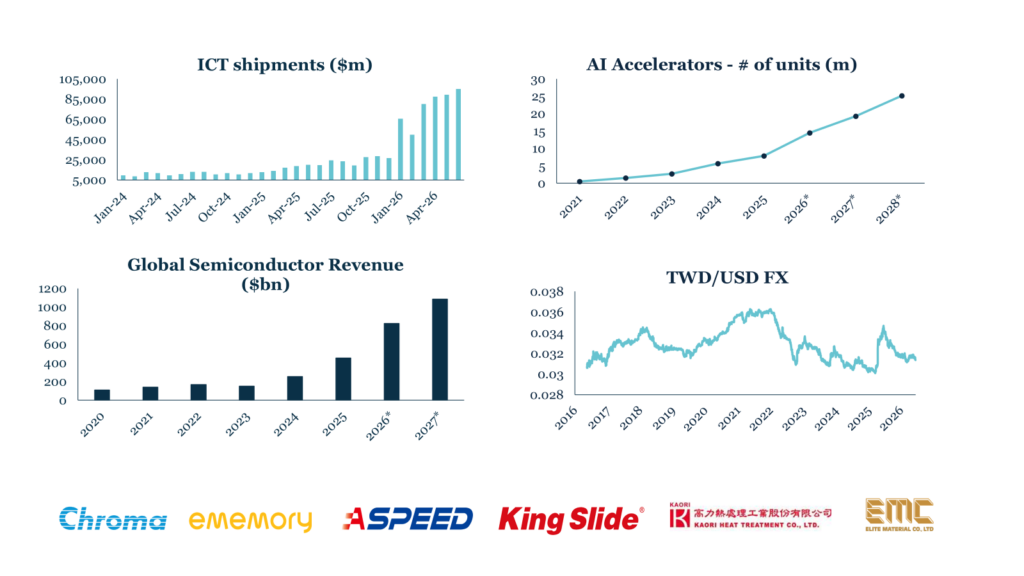
Today, artificial intelligence has broken that paradigm entirely. The semiconductor industry is now in the middle of a structural re-rating, driven not by consumer upgrade cycles but by hyperscaler capital expenditure at a scale the industry has never seen. IDC projects worldwide semiconductor revenue to reach over US$1.292 trillion this year, driven overwhelmingly by AI infrastructure investment.
The EM Supply Chain Opportunity
What makes this a particularly compelling opportunity for EM investors is the concentration of the supply chain in Asia. During Jensen Huang’s latest visit to Taiwan, he announced that NVIDIA alone was spending $150bn annually on business with its Taiwanese partners3. In total, Asian suppliers account for over 90% of the chip designer’s cost4. TSMC dominates leading-edge logic and advanced packaging, while SK Hynix and Samsung supply the HBM (High Bandwidth Memory) stacked atop every AI accelerator. More generally, a deep ecosystem of companies spanning semiconductor IP, test equipment, thermal management, power electronics and high-speed connectivity has become indispensable to AI infrastructure globally.
Taiwan’s Strong Position in AI
Source: Bloomberg, JPMorgan, Ministry of Finance ROC, CLSA. * indicates forecast. As of 30 June 2026.
Our Approach
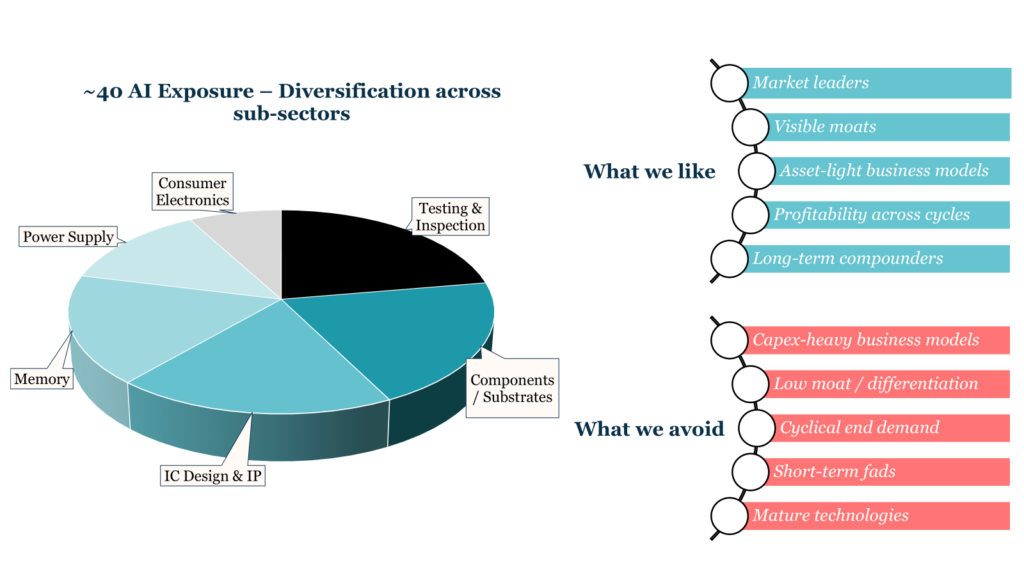
Against this backdrop, MCP has built deep coverage across the Asian technology supply chain—from semiconductor design and memory, through advanced packaging, test equipment, power supply and thermal management.
MCP’s Technology-Related Exposure
Source: MCP.
Our approach has been to try to identify the structural bottlenecks, the points in the supply chain where demand is irreplaceable, competition is limited, and switching costs are high. The companies we have built positions in are largely not household names yet are often the sole or dominant suppliers of a critical component, process or piece of intellectual property that sits at the heart of the AI infrastructure buildout. We believe this focus on bottleneck businesses offers a more durable and attractively valued way to participate in the AI cycle than owning headline hyperscalers, server assemblers or foundries directly.
The following sections set out the four themes we find most compelling today.
Datacentre Capex
The capital commitment behind AI infrastructure has reached a scale that is, by any historical measure, extraordinary, and the trajectory continues to revise upward. Global hyperscaler capital expenditure (“capex”) is expected to rise 80%+ in 2026 to $765 billion5, following 80% growth in 2025. The $1tn mark is expected to be easily surpassed in 2027, and McKinsey projects $6.7tn of spending through 20306.
Of note, the overall YoY increase stands to slow down going into 2027, with most research houses expecting a 20–25% increase. However, we believe that this may be too conservative. Leading cloud service providers are growing their operating cash flow at 30–35% as AI monetisation is accelerating from 29% last year to 50% in 20277. In addition, several companies have already demonstrated their commitment to maxing out their resources to invest in AI, recently demonstrated by Google’s $85bn equity raise8.
Oracle and the neoclouds are revising their own capex plans upwards in parallel9. Anthropic and OpenAI are running annualised revenues of approximately $45 billion and $30 billion respectively10, up roughly ten times and three times year-on-year.
Company Spotlight: King Slide Works
This Taiwanese company is the global leader in server rail systems, a critical component of AI servers. AI racks are significantly heavier and more complex than traditional servers, requiring highly engineered rail systems where reliability is paramount. Through close collaboration with customers during product development and a strong patent portfolio, King Slide has established a leading position in this niche, benefiting from high switching costs and long-term customer relationships.
We invested after extensive research into the AI supply chain, identifying King Slide as a key beneficiary of rising investment in AI infrastructure. Despite its market leadership and strong profitability, the shares were trading at an attractive valuation. We believe the company remains well positioned to benefit as hyperscalers continue to invest in increasingly sophisticated AI server architectures.
Memory
Memory chips store the data needed to operate AI models. As AI models become larger and more complex, they require significantly more memory and faster data transfer speeds. Memory has therefore become one of the key constraints in AI infrastructure. NVIDIA’s roadmap illustrates this trend. Its Hopper (H100) chips used 80GB of High Bandwidth Memory (HBM), while the upcoming Rubin platform will increase this to 288GB11, more than tripling memory capacity in less than four years.
This has transformed memory from a commodity into a strategic technology. High Bandwidth Memory (HBM), which is specifically designed for AI, is in short supply and companies such as SK Hynix and Samsung have gained significant pricing power12. Unlike traditional computing markets, AI customers cannot simply use less memory because advanced AI models require it to function effectively. With demand expected to continue outpacing supply, memory has become a structural growth market rather than a cyclical one. Within the portfolio, SK Square provides exposure to this trend through its stake in SK Hynix, while FADU, a designer of SSD controllers, is well positioned to benefit from growing demand for high-performance enterprise storage used in AI inference.
This is also changing industry dynamics. Customers are increasingly signing long-term supply agreements, reducing the boom-and-bust cycles that have historically characterised the memory industry. Beyond HBM, AI is also driving demand for enterprise storage as AI systems need to store and retrieve growing amounts of data efficiently. Memory-related equities were volatile into quarter end following a strong rally. We believe this reflected investor positioning rather than weakening fundamentals, with pricing remaining firm and demand continuing to exceed supply.
Power
Every AI data centre is, at its core, a power problem, and the scale of that problem is only now becoming clear to the broader market. While a standard server rack typically consumed 7–10 kW, an NVIDIA GB200 NVL72 rack draws 120–140 kW, and the next-generation Rubin Ultra rack system is expected to require around 600 kW13. Globally, hyperscalers have announced close to 200 GW of datacentre capacity. Large datacentre projects, including those announced by OpenAI, can consume up to 6 GW—roughly the equivalent of London’s peak electricity demand14.
Agentic AI will compound this further: as AI systems move into running autonomous workflows rather than simply responding to queries, GPU utilisation will structurally increase, which in turn leads to more power consumption. This has created an urgent and still underappreciated investment driver across the power supply chain.
A recent survey found that 50% of datacentre developers rank power availability as their single most important bottleneck15. With parts of the US electricity grid remaining constrained following decades of underinvestment, operators are now exploring options for on-site power generation, with a third of all US datacentres expected to run entirely on onsite power by 2030.
The world’s largest turbine makers such as GE or Siemens face long lead times and lengthy order backlogs, while nuclear solutions remain several years away.
This has created opportunities for alternative technologies such as Bloom Energy’s solid oxide fuel cells. The portfolio is exposed to this theme through Kaori Heat Treatment, one of the qualified suppliers of reactor chambers for Bloom Energy’s systems, and Astor Enerji, a manufacturer of high-end power transformers benefiting from strong datacentre demand.
Inference
Training is the process of teaching an AI model by feeding it vast datasets and refining its parameters. Inference is what happens every time the trained model is used, whether answering an AI prompt, analysing a medical image or executing an AI agent task. While a model may be trained once over several weeks, it can then be queried billions of times a day. This asymmetry—one training run followed by endless inference—is driving the economics of AI increasingly towards inference.
The shift is already evident. AI data centre spending has moved from roughly 80% training and 20% inference in 2024 to more than 55% inference by early 2026. For most companies, inference represents 80–90% of an AI model’s lifetime cost because every prompt requires ongoing computation. This trend is being accelerated by agentic AI, where systems autonomously complete complex, multi-step tasks such as browsing the web, writing code and reasoning across documents, requiring many more model calls for each user request.
This shift also has important implications for processors. While graphics processing units (GPUs) remain essential for training, inference workloads are often shorter, more latency sensitive and less computationally intensive, making them well suited to central processing units (CPUs). CPUs are also significantly cheaper and more widely available. As a result, CPU demand, long viewed as a mature market, is emerging as a new structural beneficiary of AI, with general-purpose server volumes expected to deliver mid-teens growth in 2026.
MCP’s portfolio company ASPEED exemplifies this opportunity, with a leading market position in baseboard management controllers used to remotely monitor both general and AI servers.
We hope this overview has provided useful insight into our thinking on the opportunities created by the rapid evolution of AI.
Carlos Hardenberg features on a full episode of Killik and Co’s Investor Insights Podcast with Gordon Smith. Carlos reflects on MCP’s differentiated investment approach and the evolving opportunity set in emerging markets, highlighting how structural shifts, particularly in AI and market leadership, are creating new winners. He discusses the resilience of EM despite geopolitical risks, including Iran, shares insights from a recent research trip to India, and emphasises the importance of active stock selection and corporate engagement. The conversation also covers where MCP is finding high-conviction opportunities today, alongside a balanced view on risks and portfolio positioning.
In a recent interview with Das Investment, Carlos Hardenberg shares his perspective on why resilience across emerging markets continues to strengthen, driven by deeper global integration and sustained investment in innovation and R&D.
He highlights the importance of focusing on high-quality, often overlooked companies that are globally competitive and benefiting from structural trends such as AI infrastructure growth. He also discusses the key drivers behind recent fund performance, particularly mid-sized technology companies experiencing strong demand and order momentum.
Carlos further outlines why he remains constructive on India despite elevated valuations, pointing to robust economic growth, improving talent dynamics, and expanding capital markets. In contrast, he takes a more cautious stance on China due to governance and shareholder alignment considerations, favouring indirect exposure through companies operating there.
Carlos von Hardenberg kommt zu Drescher & Cie und erinnert sich zusammen mit uns anlässlich des Todes des großen Schwellenländer-Fondsmanagers Dr. Mark Mobius an den Menschen, die Persönlichkeit, den Investor und sein Vermächtnis für die Nachwelt. Aus unserer Sicht ein gleichermaßen einfühlsames wie lehrreiches Gespräch für Anleger.
We are deeply saddened to learn of the passing of Mark Mobius.
Mark was not only one of the founders of MCP, but also a cherished mentor, partner, and source of inspiration to all of us. His influence on the emerging markets investment landscape was extraordinary, and his vision helped shape both our firm and the industry more broadly.
Until his retirement from the company in 2023, he remained a guiding presence and a passionate ambassador for MCP. His wisdom, energy, and generosity left a profound and lasting impression on everyone who had the privilege of working with him.
We will remember Mark not only for his remarkable achievements, but also for his character, his guidance, and the enduring impact he had on our lives. He will be greatly missed, and we hold his memory with deep respect and gratitude.
Carlos Hardenberg joins Jonathan Davis, host of the Money Makers Podcast and editor of the Investment Trusts Handbook (winner of the AIC Best Broadcast Journalist You Award 2024 and 2025), to discuss – amongst other things – the ongoing impact of the Iran War on financial markets and the investment trusts sector.
MCP wishes everyone a prosperous Chinese New Year as we are now over a week into the Year of the Fire Horse, a “Double Fire” combination symbolising energy and volatility.
In markets, “fire” could either symbolise a continuation of last year’s blistering rally or a crash and burn. Reflecting on China’s performance last year, the market appeared driven more by sentiment and liquidity injections than by earnings growth or fundamental re-ratings. The Fire Horse also symbolises independence, a theme likely to remain central to China’s strategic direction, particularly in the technology sector amid increased geopolitical tensions with the US.
The last year of the Fire Horse in 1966 stands as one of the most volatile, defining, and ultimately tragic periods in China’s modern history, marked by the beginning of the Cultural Revolution. The movement was launched by Chinese Communist Party Chairman Mao Zedong, with the stated goal to preserve communism and purge those “who have followed the path of capitalism”. Beyond the profound human tragedy, with an estimated 2 million lives lost, the revolution caused a severe economic contraction as industrial production, agriculture, and the education system were all majorly disrupted by the social and political turmoil.
China has since undergone extraordinary transformation becoming the world’s second-largest economy and home to some of the largest capital markets, such as the Shanghai Stock Exchange, only opening in 1990.
As we enter the Year of the Fire Horse, 2026 reflects the continued structural rebalancing of China’s growth drivers. GDP growth is projected at around 4.5%, with export momentum moderating and the property sector remaining a drag, albeit a diminishing one. Domestic activity is expected to remain broadly resilient, supported by measured policy actions and ongoing expansion in innovation-driven sectors. At the same time, uncertainties surrounding trade and technology policies, the trajectory of the property adjustment, and global macro conditions may contribute to continued market volatility. In this environment, a disciplined and selective approach remains warranted.