EM Tech Historically
Historically, emerging markets technology was synonymous with the consumer electronics cycle. The global semiconductor market stood at roughly US$300 billion in 20101, a market overwhelmingly driven by PCs, mobile handsets, and flat-panel displays. Growth was real but episodic, punctuated by inventory corrections and commodity memory swings, and Asian technology stocks were accordingly priced as cyclical, capital-intensive businesses tethered to end-consumer demand.
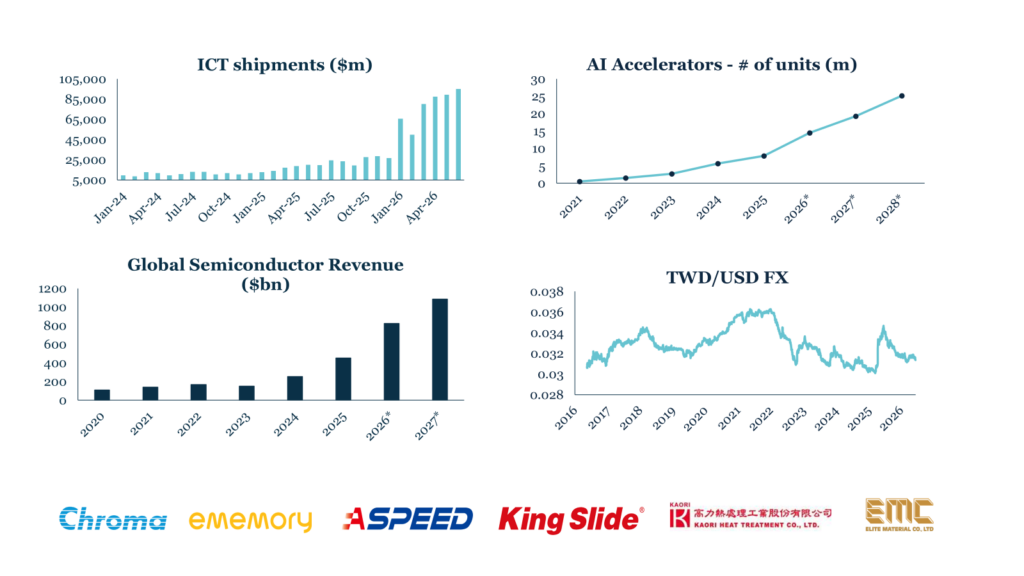
Today, artificial intelligence has broken that paradigm entirely. The semiconductor industry is now in the middle of a structural re-rating, driven not by consumer upgrade cycles but by hyperscaler capital expenditure at a scale the industry has never seen. IDC projects worldwide semiconductor revenue to reach over US$1.292 trillion this year, driven overwhelmingly by AI infrastructure investment.
The EM Supply Chain Opportunity
What makes this a particularly compelling opportunity for EM investors is the concentration of the supply chain in Asia. During Jensen Huang’s latest visit to Taiwan, he announced that NVIDIA alone was spending $150bn annually on business with its Taiwanese partners3. In total, Asian suppliers account for over 90% of the chip designer’s cost4. TSMC dominates leading-edge logic and advanced packaging, while SK Hynix and Samsung supply the HBM (High Bandwidth Memory) stacked atop every AI accelerator. More generally, a deep ecosystem of companies spanning semiconductor IP, test equipment, thermal management, power electronics and high-speed connectivity has become indispensable to AI infrastructure globally.
Taiwan’s Strong Position in AI
Our Approach
Against this backdrop, MCP has built deep coverage across the Asian technology supply chain—from semiconductor design and memory, through advanced packaging, test equipment, power supply and thermal management.
MCP’s Technology-Related Exposure
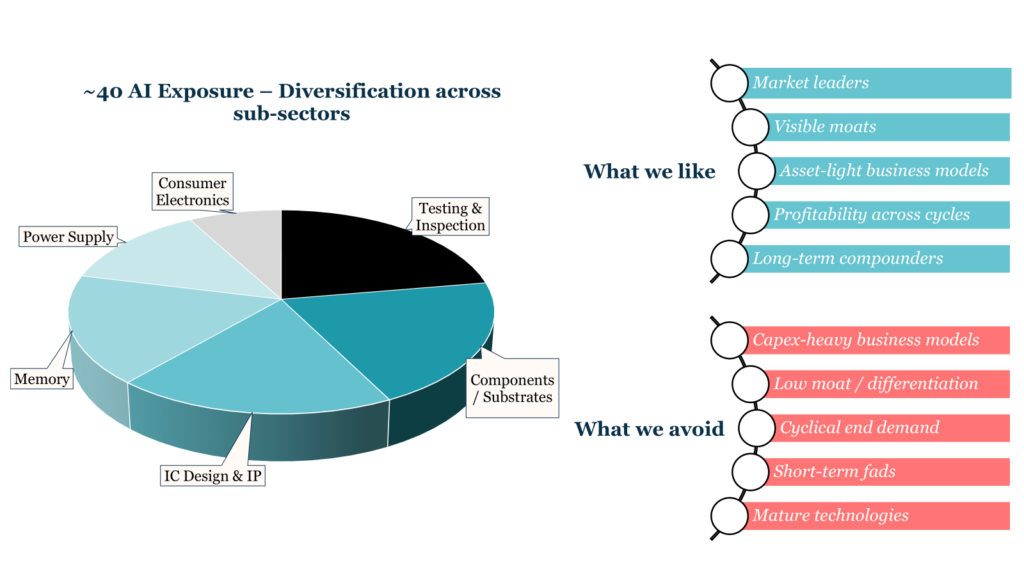
Our approach has been to try to identify the structural bottlenecks, the points in the supply chain where demand is irreplaceable, competition is limited, and switching costs are high. The companies we have built positions in are largely not household names yet are often the sole or dominant suppliers of a critical component, process or piece of intellectual property that sits at the heart of the AI infrastructure buildout. We believe this focus on bottleneck businesses offers a more durable and attractively valued way to participate in the AI cycle than owning headline hyperscalers, server assemblers or foundries directly.
The following sections set out the four themes we find most compelling today.
Datacentre Capex
The capital commitment behind AI infrastructure has reached a scale that is, by any historical measure, extraordinary, and the trajectory continues to revise upward. Global hyperscaler capital expenditure (“capex”) is expected to rise 80%+ in 2026 to $765 billion5, following 80% growth in 2025. The $1tn mark is expected to be easily surpassed in 2027, and McKinsey projects $6.7tn of spending through 20306.
Of note, the overall YoY increase stands to slow down going into 2027, with most research houses expecting a 20–25% increase. However, we believe that this may be too conservative. Leading cloud service providers are growing their operating cash flow at 30–35% as AI monetisation is accelerating from 29% last year to 50% in 20277. In addition, several companies have already demonstrated their commitment to maxing out their resources to invest in AI, recently demonstrated by Google’s $85bn equity raise8.
Oracle and the neoclouds are revising their own capex plans upwards in parallel9. Anthropic and OpenAI are running annualised revenues of approximately $45 billion and $30 billion respectively10, up roughly ten times and three times year-on-year.
Company Spotlight: King Slide Works
This Taiwanese company is the global leader in server rail systems, a critical component of AI servers. AI racks are significantly heavier and more complex than traditional servers, requiring highly engineered rail systems where reliability is paramount. Through close collaboration with customers during product development and a strong patent portfolio, King Slide has established a leading position in this niche, benefiting from high switching costs and long-term customer relationships.
We invested after extensive research into the AI supply chain, identifying King Slide as a key beneficiary of rising investment in AI infrastructure. Despite its market leadership and strong profitability, the shares were trading at an attractive valuation. We believe the company remains well positioned to benefit as hyperscalers continue to invest in increasingly sophisticated AI server architectures.
Memory
Memory chips store the data needed to operate AI models. As AI models become larger and more complex, they require significantly more memory and faster data transfer speeds. Memory has therefore become one of the key constraints in AI infrastructure. NVIDIA’s roadmap illustrates this trend. Its Hopper (H100) chips used 80GB of High Bandwidth Memory (HBM), while the upcoming Rubin platform will increase this to 288GB11, more than tripling memory capacity in less than four years.
This has transformed memory from a commodity into a strategic technology. High Bandwidth Memory (HBM), which is specifically designed for AI, is in short supply and companies such as SK Hynix and Samsung have gained significant pricing power12. Unlike traditional computing markets, AI customers cannot simply use less memory because advanced AI models require it to function effectively. With demand expected to continue outpacing supply, memory has become a structural growth market rather than a cyclical one. Within the portfolio, SK Square provides exposure to this trend through its stake in SK Hynix, while FADU, a designer of SSD controllers, is well positioned to benefit from growing demand for high-performance enterprise storage used in AI inference.
This is also changing industry dynamics. Customers are increasingly signing long-term supply agreements, reducing the boom-and-bust cycles that have historically characterised the memory industry. Beyond HBM, AI is also driving demand for enterprise storage as AI systems need to store and retrieve growing amounts of data efficiently. Memory-related equities were volatile into quarter end following a strong rally. We believe this reflected investor positioning rather than weakening fundamentals, with pricing remaining firm and demand continuing to exceed supply.
Power
Every AI data centre is, at its core, a power problem, and the scale of that problem is only now becoming clear to the broader market. While a standard server rack typically consumed 7–10 kW, an NVIDIA GB200 NVL72 rack draws 120–140 kW, and the next-generation Rubin Ultra rack system is expected to require around 600 kW13. Globally, hyperscalers have announced close to 200 GW of datacentre capacity. Large datacentre projects, including those announced by OpenAI, can consume up to 6 GW—roughly the equivalent of London’s peak electricity demand14.
Agentic AI will compound this further: as AI systems move into running autonomous workflows rather than simply responding to queries, GPU utilisation will structurally increase, which in turn leads to more power consumption. This has created an urgent and still underappreciated investment driver across the power supply chain.
A recent survey found that 50% of datacentre developers rank power availability as their single most important bottleneck15. With parts of the US electricity grid remaining constrained following decades of underinvestment, operators are now exploring options for on-site power generation, with a third of all US datacentres expected to run entirely on onsite power by 2030.
The world’s largest turbine makers such as GE or Siemens face long lead times and lengthy order backlogs, while nuclear solutions remain several years away.
This has created opportunities for alternative technologies such as Bloom Energy’s solid oxide fuel cells. The portfolio is exposed to this theme through Kaori Heat Treatment, one of the qualified suppliers of reactor chambers for Bloom Energy’s systems, and Astor Enerji, a manufacturer of high-end power transformers benefiting from strong datacentre demand.
Inference
Training is the process of teaching an AI model by feeding it vast datasets and refining its parameters. Inference is what happens every time the trained model is used, whether answering an AI prompt, analysing a medical image or executing an AI agent task. While a model may be trained once over several weeks, it can then be queried billions of times a day. This asymmetry—one training run followed by endless inference—is driving the economics of AI increasingly towards inference.
The shift is already evident. AI data centre spending has moved from roughly 80% training and 20% inference in 2024 to more than 55% inference by early 2026. For most companies, inference represents 80–90% of an AI model’s lifetime cost because every prompt requires ongoing computation. This trend is being accelerated by agentic AI, where systems autonomously complete complex, multi-step tasks such as browsing the web, writing code and reasoning across documents, requiring many more model calls for each user request.
This shift also has important implications for processors. While graphics processing units (GPUs) remain essential for training, inference workloads are often shorter, more latency sensitive and less computationally intensive, making them well suited to central processing units (CPUs). CPUs are also significantly cheaper and more widely available. As a result, CPU demand, long viewed as a mature market, is emerging as a new structural beneficiary of AI, with general-purpose server volumes expected to deliver mid-teens growth in 2026.
MCP’s portfolio company ASPEED exemplifies this opportunity, with a leading market position in baseboard management controllers used to remotely monitor both general and AI servers.
We hope this overview has provided useful insight into our thinking on the opportunities created by the rapid evolution of AI.
Leave a Reply