Since its official founding on 15 August 1948, South Korea has achieved remarkable economic success, combined with a turbulent journey towards democracy. The first 30 years of the nation’s history were dominated by authoritarian rule, with martial law frequently employed to maintain dictatorial control. It was not until 1987 that a democratic system was firmly established. Since then, the country has maintained a stable democracy, free from military coups and widely regarded as one of the most democratic countries in the region over the recent decades despite its young age.
However, that perception changed dramatically on 3 December 2024 when President Yoon Suk Yeol declared martial law on the grounds of protecting the country from “anti-state” forces sympathetic to North Korea. This caused international alarm around the state of the country’s democracy. South Korea’s standing in global democracy rankings declined sharply. For example, in the Economist Intelligence Unit’s Democracy Index 2024, the country fell to 32nd out of 167, down from 22nd in 2022.
However, we believe that the swift institutional response to this crisis, paradoxically, reaffirms the strength of South Korea’s democratic framework. The National Assembly acted quickly, suspending Yoon from office and initiating impeachment proceedings. On 14 December, Yoon was formally impeached and stripped of his presidential powers. Yoon was then arrested on 15 January 2025, following a failed attempt on 3 January 2025 as forces withdrew due to concerns for the safety of their personnel following resistance from pro-Yoon demonstrators and a military unit defending Yoon.
On 4 April, the Constitutional Court unanimously upheld the impeachment, officially ending Yoon’s presidency. A snap presidential election has been scheduled for 3 June, with several politicians having served as acting president in the interim period, including Han Duck-soo, Choi San-mok, and currently Lee Ju-ho.
So what are the implications of this impeachment crisis for South Korean democracy?
Despite the initial shock of martial law, the nation’s swift return to constitutional order is a testament to the fact that its institutional processes are capable of defending its democracy in the face of an extreme threat. The impeachment and lawful arrest of a sitting president sends a clear message that abuses of power will not be tolerated, and that the country’s institutional checks and balances are robust and functional.
The next president will take office against the backdrop of this crisis, acutely aware of subsequent public dismay it caused demonstrated by millions of people taking to the streets of Seoul to peacefully protest for Yoon’s arrest over several months. These protests were witnessed first-hand by an MCP analyst during a research trip to Korea in February.
So that leads on to the question of who will be the next President?
Lee Jae-myung, the Democratic Party (DKP) presidential candidate, has been the leader of the centre-leftist party since 2022. He lost the 2022 general election to Yoon Suk Yeol only by a margin of 0.8%. Additionally, he played a significant role in the impeachment of Yoon. However, Lee himself is not free from controversy and is actually contesting criminal charges around alleged bribery linked to a $1bn property development scandal. Courts have agreed to push back further hearings until after the election.
Kim Moon-soo is the People Power Party (PPP) presidential candidate, the current right-wing ruling party. He served as the minister of employment and labour from 2024 to 2025. While Kim publicly disagreed with President Yoon’s decision to declare martial law, notably he refrained from joining other cabinet members in issuing a formal apology and he opposed Yoon’s impeachment. Kim has resultingly gained much support from Yoon loyalists but has struggled to broaden support beyond this group. In the Gallup Korea poll released on 16 May, Kim trailed significantly behind Lee who led with 51% support compared to Kim’s 29%.
Not only is this election set in the aftermath of the recent impeachment crisis, it is also taking place amid the current global tariff crisis. Korea was one of the first countries to hold official trade talks with the US. The new president will be responsible for continuing these crucial negotiations in an attempt to prevent a potential 25% tariff on Korean exports to the US. This measure could be implemented on 8 July, when the current 90-day pause expires, if no trade agreement has been reached.
Moreover, the tariff crisis is set to exacerbate the country’s existing economic problems, which include low growth and a rapidly ageing population. It is hoped that, once the leadership vacuum has been filled, the country will be better able to respond to its current economic problems.
The first televised debate between the leading candidates took place on 18 May and included Lee, Kim, Lee Jun-seok of the minor centrist Reform Party and Kwon Young-kook of the minor progressive Democratic Labor Party.
In terms of the economy, Lee said that the government should play a more active role in stimulating domestic demand and promoting growth in key sectors such as the high-tech and renewable energy. This would involve development a form of ‘sovereign AI’ – something he likened to a similar, but free version of ChatGPT for the nation.
He promised to work towards promptly implementing a supplementary budget to boost the domestic economy and benefit ordinary people, as well as providing greater protection for unionised workers and introducing a four-and-a-half-day working week.
Meanwhile, Kim promised to create jobs, deregulate by creating a government agency dedicated to innovating regulations, and to invest more than five percent of the budget in research and development to spur economic growth.
Regarding the U.S, Lee and Kim promised to take very different approaches, with Lee preferring to take time to hash out a trade deal with the US that will ensure Korea benefits. In contrast, Kim emphasised the importance of South Korea’s alliance with the U.S., and that he would seek to hold a summit with Trump as soon as taking office in order to accelerate trade negotiations.
Additionally, Lee has called for constitutional reform to allow a four-year, two-term presidency and a two-round system for presidential elections through a referendum, in contrast to the single five-year term president’s currently serve. He also vowed to curb the presidential right to declare martial law and to hold account those responsible for the 3 December declaration.
It is also worth pointing out that the DKP pushed through a revision of the Commercial Act in March which expands the fiduciary duty of board members to act not only in the interest of the company, but also to protect the interests of minority shareholders and improve board independence. However, the PPP under acting president Han Duck-soo vetoed the amendment on the basis of over regulation. More broadly, Lee has vowed to renew efforts in support of the Value Up Program in order to improve corporate governance and raise Korean valuations, despite this initially being an initiative under Yoon Suk Yeol’s presidency.
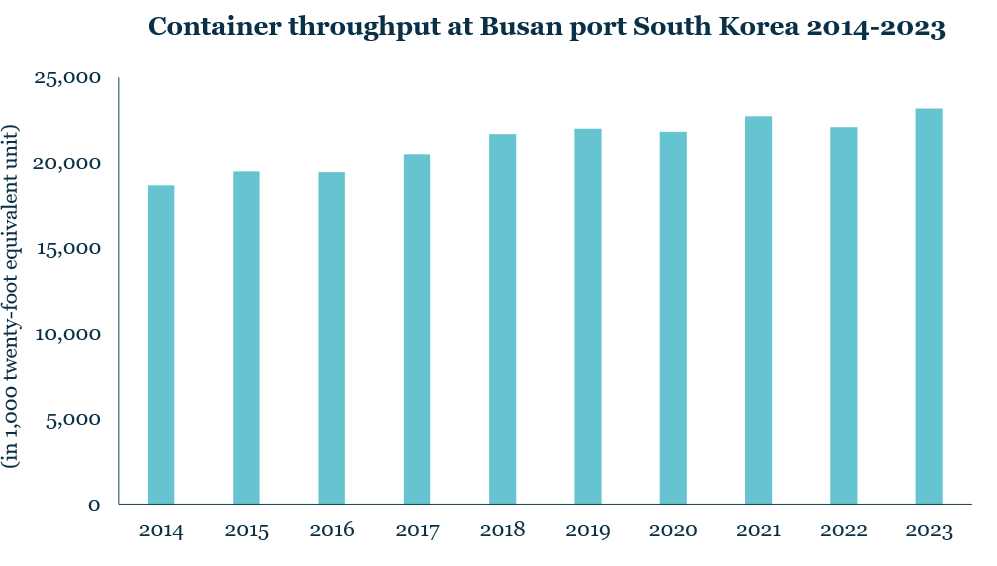
We will continue to monitor the ongoing political and economic developments in South Korea closely, assessing the impact of the next president’s policies on the country’s economy, its Value Up Program and our portfolio specifically. We believe that the new president must prioritise securing a favourable trade deal and restoring the international communities’ trust in the country’s democracy and institutional processes. Overall, we remain fundamentally confident in the country’s stability and its promising investment opportunities, particularly in the export market. For example, the chart below shows a significant increase in import and export traffic through Korea’s primary port, Busan, over the past decade.
Leave a Reply