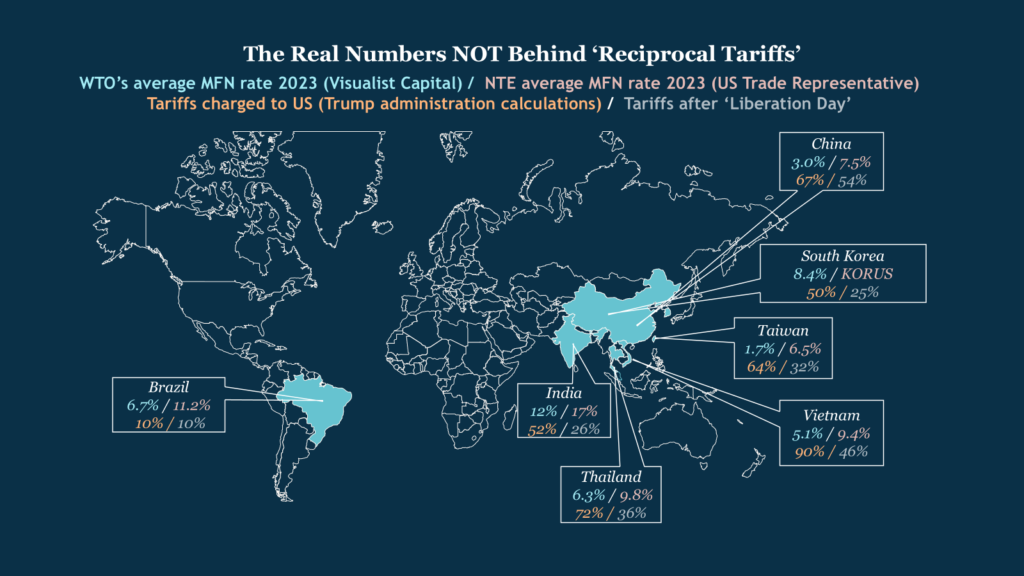
It doesn’t take much scrutiny to spot the flippant misinformation Trump often spreads on platforms like X and Truth Social, but he has now taken it a step further by incorporating fake news into the government’s official tariff policy. On ‘Liberation Day,’ Trump held up a board displaying the tariffs on US imports of the 60 ‘worst offenders’. The figures were shocking, such as Vietnam’s 90% tariff on U.S. imports, which could indeed justify an increased U.S. tariff in return.
However, these figures are blatantly false as they were calculated using an arbitrary and misleading formula: the US trade deficit with a country divided by the value of that country’s exports to the US in 2024. The reciprocal tariff rate is the resulting figure halved and rounded up.
In reality, the data tell a very different story. According to the 2025 National Trade Estimate (NTE) released by the Office of the US Trade Representative on March 31 2025, Vietnam’s average Most-Favored-Nation (MFN) applied tariff rate in 2023 was 9.4%. The report even says ‘‘the majority of U.S. exports to Vietnam face tariffs of 15 percent or less’’, with certain consumer-oriented food and agricultural products facing higher rates. Meanwhile, Visualist Capital’s mapping of WTO’s trade weighted average of MFN tariff rates shows Vietnam’s average is just 5.1%. An MFN tariff is one which applies equally to all WTO member countries, excluding special trade agreements.
Vietnam’s incorrect calculation is no fluke, take other countries and the data shows the US’s new calculations have highly inflated the number. An even greater discrepancy is evident in the case of South Korea which has almost entirely removed tariffs on US imports since the United States–Korea Free Trade Agreement (KORUS) enacted in 2012. The Korea Economic Institute of America calculated an average of 0.3-3.6% Korean tariffs on US imports in 2023.
This flawed methodology disproportionately penalises poorer, export-driven countries with large trade surpluses but limited imports from the US. For example, according to data from the US Consensus Bureau, while the EU’s trade surplus with the US is much larger (-$236 billion) than Vietnam’s (-$123 billion), the administration’s formula assigns a much higher tariff to Vietnam simply because it imports less in return ($13 bn vs $370 bn).
Leave a Reply